Categorias
Novo Blog
Cooling is one of the most important stages in caramel popcorn manufacturing, especially when the finished product needs to maintain a crisp texture, an even coating, and a clean appearance before packaging. Although the popping and caramelizing processes receive much of the attention, the way coated popcorn is cooled can have a direct impact on its handling characteristics and overall production efficiency.
Freshly caramel-coated popcorn is typically warm, and its sugar-based coating may remain soft or tacky immediately after processing. If the product is transferred or packaged before reaching suitable conditions, individual pieces may stick together, accumulate on equipment surfaces, or become difficult to handle consistently.
For industrial popcorn factories, an appropriately designed cooling stage helps prepare caramel-coated popcorn for inspection, separation, conveying, and packaging. XFD provides industrial cooling and filtering equipment that can be integrated into popcorn production systems according to product and capacity requirements.
During caramel popcorn production, the coating ingredients are heated and mixed with popped kernels. After the coating process, the product retains heat from both the caramel preparation and the mixing operation.
At this point, the caramel layer may not yet have reached its intended final texture. The product needs an appropriate cooling period so that the coating can stabilize before further handling.
Without sufficient cooling, several production issues may occur:
Cooling does not simply mean bringing popcorn to room temperature as quickly as possible. The objective is to establish suitable product conditions for the next operation while protecting the coating and the physical structure of the popcorn.
The texture of caramel popcorn is influenced by the formulation of the coating, cooking temperature, sugar concentration, moisture content, and cooling conditions. Once the coated popcorn leaves the caramelizer, temperature reduction helps the coating develop its intended physical characteristics.
If cooling is insufficient, the caramel layer may remain soft for longer than expected. This can make the product more likely to stick together during conveying, temporary storage, or packaging.
However, excessively aggressive cooling should not automatically be considered the best solution. Very rapid or uneven temperature changes may create differences between individual product pieces, particularly when popcorn enters the cooling stage in thick layers or uneven batches.
Manufacturers should therefore evaluate the following factors:
It is important to remember that cooling alone cannot compensate for an unsuitable caramel recipe or poor moisture control. Consistent finished-product quality requires coordination between caramel preparation, coating, cooling, and packaging.
One of the practical challenges in caramel popcorn factories is transferring coated popcorn from the caramelizer to the next processing stage without creating unnecessary product accumulation.
When caramel-coated popcorn is still too warm, the coating may be more susceptible to sticking during contact with other pieces or equipment surfaces. Repeated accumulation can interrupt material flow and increase the need for manual intervention.
A suitable cooling and conveying arrangement helps manufacturers manage this transition more effectively.
When evaluating the equipment, consider:
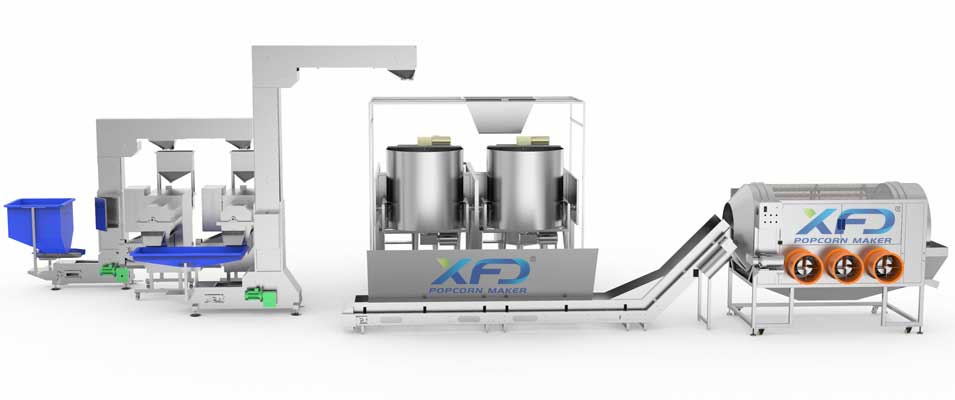
For larger factories, XFD's industrial production systems can incorporate conveying and cooling equipment into a connected workflow. Its factory hot-air popcorn machine and caramelizer production line includes a Z-type elevator and a cooling and separating machine for downstream product handling.
This arrangement helps coordinate the movement of flavored popcorn between processing stages. The exact equipment configuration should still be selected according to the coating process, output requirements, and factory layout.
An industrial popcorn cooling and filtering machine can perform more than one function. Depending on its design, it may combine airflow cooling, product movement, screening, and separation within a single processing stage.
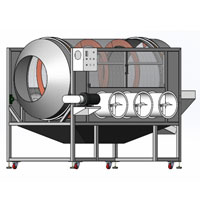
XFD's rotating vibrating drum sieve cooling and filtering machine is designed to cool popcorn while separating undersized materials from the main product flow.
According to its product specifications, the machine uses multiple high-speed cooling blowers. As popcorn moves through the inclined rotating drum, the material rolls and moves along the screening surface. Smaller particles that pass through the screen are separated, while the larger product exits at the other end.
Its main functions include:
For factories processing caramel popcorn, this type of equipment is worth evaluating when cooling and material separation are both required. However, the screening specifications should be checked carefully to ensure that the desired product size is retained and valuable popcorn is not unnecessarily removed.
Learn more about XFD's industrial popcorn cooling and filtering machine for detailed equipment specifications and configuration information.
A cooling system should be selected according to the actual quantity of coated popcorn entering the equipment, not simply the nominal output of the popping machine.
For example, a factory may have sufficient popping capacity but still experience interruptions if the caramelizer produces finished product faster than the cooling stage can process it. This creates a bottleneck between coating and packaging.
When selecting a cooling machine, manufacturers should compare:
It is also useful to consider temporary buffering capacity. A production line needs enough flexibility to handle short interruptions without allowing large quantities of warm caramel popcorn to accumulate in an uncontrolled area.
For example, XFD's cooling and filtering machine is listed with a power rating of 7 kW and dimensions of 3500 × 2100 × 1950 mm. Its configuration uses a rotating drum and multiple cooling fans. These specifications provide a starting point for installation planning, but actual cooling performance and throughput should be confirmed for the intended popcorn product.
Packaging is the final stage before caramel popcorn enters storage and distribution. However, packaging should not begin simply because the coating operation has finished.
Before packing, manufacturers should confirm that the caramel popcorn has reached a suitable condition for weighing, filling, and sealing.
Several indicators can help operators evaluate packaging readiness:
Packaging warm caramel popcorn can create problems if heat and moisture become trapped inside the sealed package. This may contribute to changes in coating texture and product crispness during storage.
For this reason, cooling conditions should be evaluated together with the packaging material. Manufacturers should consider the required moisture barrier, seal integrity, package size, and expected storage conditions.
The cooling system and XFD popcorn processing equipment range should be planned as part of the complete production workflow rather than treated as separate purchasing decisions.
When cooling performance does not match production requirements, several issues may become noticeable during daily operation.
| Production Problem | Possible Cause | What to Check |
|---|---|---|
| Sticky caramel popcorn | Insufficient cooling or coating formulation issues | Cooling time, product temperature, and recipe |
| Popcorn pieces clumping together | Product entering transfer equipment too warm | Cooling airflow and product loading |
| Uneven cooling | Uneven material distribution or restricted airflow | Fan arrangement and drum loading |
| Excessive small fragments | Mechanical handling or unsuitable transfer conditions | Drop height, movement speed, and screening settings |
| Packaging interruptions | Cooling output below packaging demand | Throughput balance across the production line |
These problems do not always originate from the cooling machine itself. Caramel formulation, product moisture, upstream processing, and factory humidity can also influence the results. A systematic inspection of the entire process is more effective than changing cooling settings without identifying the cause.
For factories producing caramel popcorn at commercial or industrial volumes, the cooling stage should be designed around the complete production sequence.
A typical workflow may look like this:
Kernel Feeding
↓
Popcorn Popping
↓
Caramel Preparation and Coating
↓
Conveying to Cooling Equipment
↓
Cooling and Filtering
↓
Product Inspection and Handling
↓
Weighing and Packaging
The exact arrangement depends on the selected popping technology, coating process, and machine configuration. Some systems combine cooling with other operations, while others use separate equipment for different stages.
XFD provides industrial popcorn production solutions that combine popping, caramelizing, conveying, cooling, and other processing equipment. Its industrial popcorn production and coating line is designed for large-scale caramel and chocolate popcorn manufacturing, with a listed capacity range of approximately 180–250 kg/h for the specified configuration.
When planning a new line, manufacturers should discuss their target output, caramel recipe, cooling requirements, packaging format, and available installation space with the equipment supplier. This makes it easier to select a suitable cooling arrangement and avoid unnecessary production bottlenecks.
Why does caramel popcorn need to cool before packaging?
Cooling allows the caramel coating to stabilize and helps prepare popcorn for handling, weighing, and packaging. It also reduces the risk of trapping excessive heat and moisture inside sealed packages.
What happens if caramel popcorn is packaged while still warm?
Warm caramel popcorn may stick together or develop unwanted moisture-related texture changes inside the package. The appropriate packaging temperature should be established through production testing and validated process requirements.
What type of cooling machine is suitable for industrial popcorn production?
A suitable industrial cooling and filtering machine should provide sufficient airflow, material movement, and screening capacity for the required production output. Rotating drum cooling equipment can be considered when both cooling and separation are required.
Can a popcorn cooling machine also remove small fragments?
Yes. Some cooling and filtering machines combine cooling fans with a rotating screening drum. Smaller particles can pass through the screen openings while larger popcorn pieces continue toward the discharge end.
How many cooling fans does an industrial popcorn cooling machine need?
The required number depends on equipment design, airflow, product loading, and cooling requirements. XFD's rotating vibrating drum sieve cooling and filtering machine is specified with 6–8 cooling fans. The suitable configuration should be confirmed for the actual product and production capacity.
How do I prevent caramel popcorn from sticking during cooling?
Check the coating formulation, product temperature, cooling airflow, product loading, and residence time. Uniform material distribution and suitable cooling conditions can help reduce sticking and product accumulation.
Does a larger popcorn production line always need a separate cooling machine?
Not necessarily. Some industrial popcorn systems incorporate cooling and filtering functions into other equipment, while larger or more specialized production arrangements may use a dedicated cooling machine. The decision depends on the recipe, required throughput, and complete line design.
How can I select the right cooling equipment for caramel popcorn?
Start with the actual coated popcorn output, required cooling conditions, product size, screening needs, factory space, and downstream packaging speed. Ask the supplier to confirm the equipment's practical performance using the intended production conditions.
Cooling equipment plays an important role in preparing caramel-coated popcorn for consistent handling and packaging. It helps manage product temperature, supports coating stabilization, and can combine material separation with downstream product transfer.
For manufacturers planning to improve their caramel popcorn production process, XFD offers industrial cooling and filtering equipment as well as integrated popcorn production and coating lines. Choosing the right configuration can help create a smoother workflow from caramel coating to finished-product packaging.
 No.58 TongMing Road,TongAn District,XiaMen City,FuJian Province
 +86-592-5701935
Se você está interessado em quaisquer XFD produto, por favor, deixe-nos uma mensagem que responderemos em breve.
Copyright © 2012-2026 XFD XIAMEN MACHINERY TECHNOLOGY LTD..Todos os direitos reservados.
 português
 English
 Deutsch
 русский
 español
 Nederlands
 العربية
 हिंदी


